
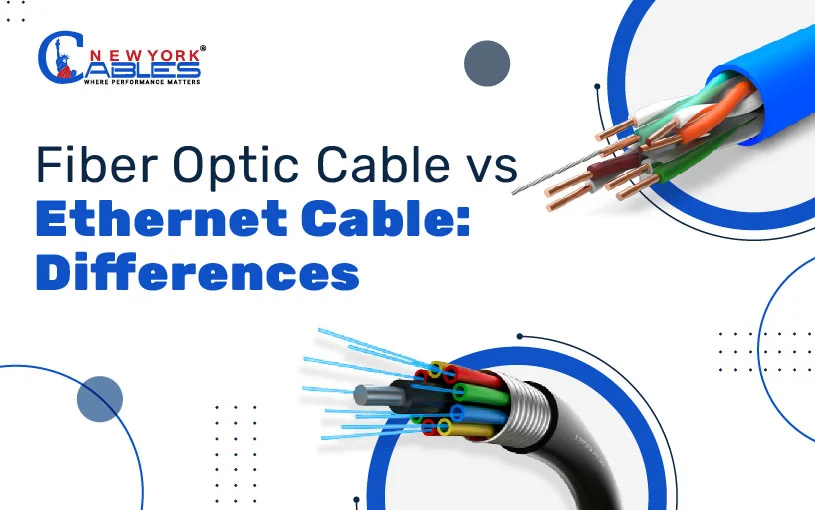
In today's hyper-connected world, selecting the appropriate cabling infrastructure is crucial for building networks that are not only efficient but also reliable. The decision between implementing fiber optic cables or traditional Ethernet cables can profoundly influence your network's performance, scalability, and long-term viability. Grasping the distinctions between these two cabling options—including their unique advantages and optimal use cases—is essential for making informed networking choices that align with your specific requirements and future-proof your infrastructure.
What Are Ethernet Cables?
Ethernet cables are the lifelines of Local Area Networks (LANs) and Wide Area Networks (WANs), facilitating data communication between devices. They come in three primary types:
- Twisted-Pair Cables: These are the most common, featuring pairs of copper wires twisted together to reduce electromagnetic interference (EMI).
- Fiber Optic Cables: Utilizing light to transmit data, these cables offer high-speed communication over long distances.
- Coaxial Cables: Consisting of a central conductor surrounded by insulation and shielding, they are often used for cable television but can also support data networks.
Fiber Optic Cables
Fiber optic cables transmit data as light pulses through strands of glass or plastic fibers, enabling rapid data transfer with minimal loss. They are categorized into two main types:
- Single-Mode Fiber (SMF): Designed for long-distance communication, SMF carries a single light beam, reducing signal loss over extensive ranges.
- Multi-Mode Fiber (MMF): Suitable for shorter distances, MMF carries multiple light beams simultaneously but may experience higher signal loss over long distances.
Fiber optic cables are integral to global internet infrastructure, connecting continents and countries beneath oceans. The core fiber is thinner than a human hair yet supports unparalleled data transmission speeds.
-
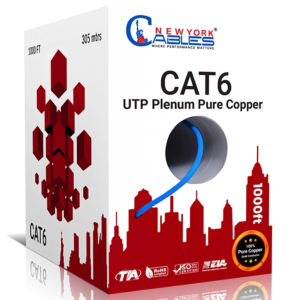 Cat6 Plenum Pure Copper CMP 550MHz 1000ft Ethernet 23AWG UTP CableAs low as $170.00 Regular Price $244.99
-
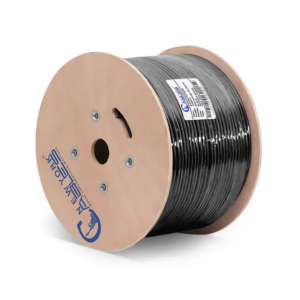 Cat6a Plenum Bare Copper Wooden Spool 1000ftAs low as $243.99 Regular Price $319.99
Which Fiber Optic Cable do you need?
When considering fiber optic cables for your network, the choice between single-mode and multimode fibers is crucial. Single-mode fibers are designed for long-distance transmissions, making them ideal for connecting networks across campuses or between buildings.
In contrast, multimode fibers have wider cores, allowing them to carry larger amounts of data simultaneously, which is effective in environments where the distance between ports is not too long, such as offices where network hubs are usually within a short distance to their end terminals.
Twisted-Pair Cables
Twisted-pair cables are prevalent in various settings, from homes to offices. They consist of eight copper conductors twisted into four pairs, a design that minimizes EMI and ensures reliable connectivity. These cables are often synonymous with Ethernet cables due to their widespread use.
Which one to Buy?
When selecting a twisted-pair Ethernet cable for your network, it's essential to consider both your current and future bandwidth requirements. For standard home networks primarily used for activities like browsing, streaming, and online gaming, Cat5e cables are a cost-effective choice, supporting speeds up to 1 Gbps over 50 meters.
However, if you're looking to future-proof your network or anticipate higher data demands, Cat6 cables offer enhanced performance, supporting speeds up to 10 Gbps over shorter distances and providing better protection against crosstalk and interference.
For environments requiring consistent 10 Gbps performance over longer distances, Cat6a cables are recommended, as they offer improved shielding and reduced signal degradation.
Fiber Optic vs. Copper Ethernet Cables: Key Differences
Understanding the distinctions between fiber optic and twisted-pair copper Ethernet cables is crucial:
- Data Transmission: Fiber optic cables use light, allowing for faster data transfer and longer distances without significant loss. Twisted-pair cables use electrical signals, which are more susceptible to interference and signal degradation over distance.
- Speed: Fiber optic cables can support terabit-per-second speeds, whereas twisted-pair cables typically support up to 10 gigabits per second.
- Durability: Twisted-pair cables are generally more robust and can withstand physical impacts better than the more fragile fiber optic cables.
- Cost: Fiber optic cables often involve higher initial costs due to materials and installation requirements, while twisted-pair cables are more cost-effective for shorter distances.
Pros and Cons of Fiber Optic Cables
Pros:
- High-Speed Transmission: Supports extremely high data rates, essential for modern applications.
- Long-Distance Capability: Maintains signal integrity over extensive distances, ideal for connecting geographically dispersed networks.
- Immunity to EMI: Unaffected by electromagnetic interference, ensuring stable performance in various environments.
Cons:
- Fragility: Sensitive to bending and physical stress, requiring careful handling and installation.
- Higher Initial Cost: More expensive materials and specialized installation can increase upfront expenses.
Pros and Cons of Twisted-Pair Ethernet Cables
Pros:
- Cost-Effective: Lower initial investment makes them accessible for various applications.
- Durability: Robust construction allows them to withstand physical stress, making them suitable for various environments.
- Ease of Installation: Simpler installation process without the need for specialized equipment.
Cons:
- Limited Speed and Distance: Lower data transfer rates and effective over shorter distances compared to fiber optics.
- Susceptibility to EMI: Electrical signals can be affected by electromagnetic interference, potentially impacting performance.
Choosing the Right Cable for Your Needs
Selecting between fiber optic and twisted-pair Ethernet cables depends on several factors:
- Distance: For long-distance transmissions, fiber optic cables are preferable due to minimal signal loss.
- Bandwidth Requirements: High-speed applications benefit from the superior data rates of fiber optics.
- Budget: Twisted-pair cables offer a cost-effective solution for shorter distances and less demanding applications.
- Installation Environment: Environments with high EMI or where security is a concern may favor fiber optic cables.
In a Nutshell
The choice between fiber optic cables and twisted-pair Ethernet cables hinges on your specific networking requirements. Fiber optic cables excel in delivering ultra-high-speed data transmission over long distances, making them ideal for backbone infrastructures and environments where electromagnetic interference is a concern. However, they tend to be more fragile and costly. On the other hand, twisted-pair Ethernet cables, such as Cat6 or Cat6a, offer a cost-effective and durable solution for most local area networks, supporting substantial data speeds suitable for everyday applications.
FAQs
Is fiber optic cable the same as Ethernet cable?
Fiber optic cable is a type of Ethernet cable, alongside twisted-pair and coaxial cables, all used for data communication.
Is fiber optic cable better than Ethernet?
Fiber optic cables offer higher speeds and longer distance capabilities, but the choice depends on specific network requirements.
Can fiber optic cable be used as an Ethernet cable?
Yes, fiber optic cables are used in Ethernet networks, especially where high-speed and long-distance transmission are needed.
Are copper Ethernet cables faster than fiber optic cables?
No, fiber optic cables generally provide faster data transmission than copper Ethernet cables.
Is Cat6 fiber or copper cable?
Cat6 refers to a category of twisted-pair copper cables, not fiber optic.
Do I need a special Ethernet cable for fiber?
Yes, connecting to a fiber optic network requires appropriate fiber optic cables, either single-mode or multi-mode, depending on the application.
