
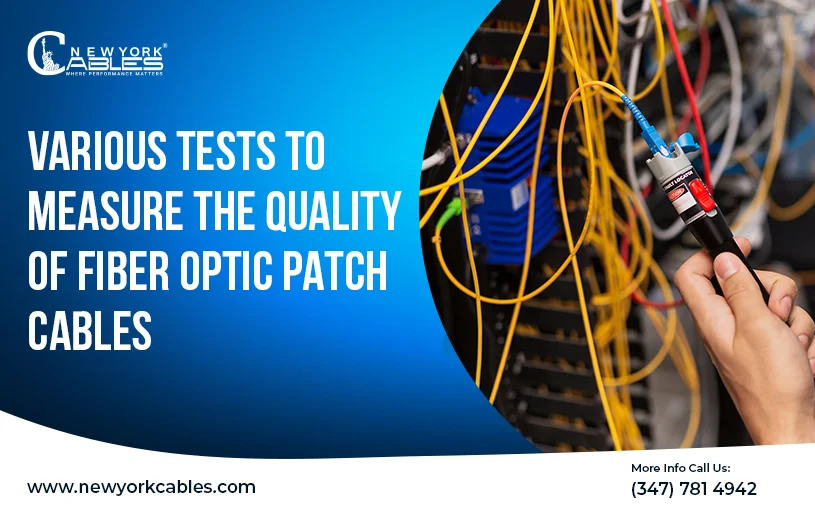
Not all fiber optic cables are created equal. If you are serious about performance, you cannot afford to rely on specifications alone. Behind every high-performing fiber cable is a series of quality tests that manufacturers must run. These tests are the frontline defense against signal loss, latency spikes, and network downtime.
If a cable has not passed these tests, it should not be anywhere near your setup. Here are three tests that truly matter when judging fiber optic quality.
1. 3D Interferometry — The Polished Truth
It involves inspection of a connector’s endface at the microscopic level by measuring curve, tilt, and height differences down to a micron. It might sound technical, but the impact is huge. Three key areas are inspected in this test which includes apex offset, fiber height, and radius of curvature.
Apex Offset
This is the distance between the fiber core and the highest point on the ferrule’s polished surface. If this is off, signal transfer suffers. Bad polishing leads to weak network performance.
Fiber Height
Possibility of physical damage increases if the fiber core sticks out too much. Air gaps are created when cable is recessed extremely. The sweet spot is razor-thin, and only a proper 3D surface test can guarantee it.
Radius of Curvature
This refers to the roundness of the ferrule’s surface. Excessive roundness can lead to crushed glass. Light cannot transfer if the radius is too shallow due to compression.. Goldilocks curvature is essential to get rid of this problem.
Important note: If a patch cable does not undergo interferometric inspection, it is not built for serious networking.
2. Endface Cleanliness — Because Microscopic Dirt Can Wreck Your Link
Endface contamination is the top cause of fiber link failure. A tiny particle of dust on the endface can severely affect your network. For instance, a microscopic speck on the ferrule can;
- Create back-reflection (a silent killer for signal quality)
- Increase return loss
- Cause permanent scratching or pitting when two dirty connectors are mated
For this reason, every reputable manufacturer, including us, runs automated and manual inspections of every connector’s endface. It’s also why field engineers always carry inspection scopes and cleaning pens. These steps are critical if you want to enjoy stable network performance.

3. Insertion Loss & Return Loss — The Signal Strength Test
When it comes to signal quality, insertion loss (IL) and return loss (RL) are important factors.
Insertion Loss (IL) measures how much signal strength you lose when the cable is introduced into the system.
Return Loss (RL) measures how much signal reflects back toward the source. The higher this number, the better performance.
According to TIA standards, acceptable IL tops out at 0.75dB, but top-shelf connectors (like ours) stay well below that, in the 0.3 to 0.5dB range. That is where clean signal, tight mating, and high polish quality all pay off.
Bad IL and RL numbers means slower speeds, weaker transmission, and more errors. Every dB counts if you want to experience speeds of 10G to 40G over long distances.
Final Thoughts
If a fiber optic patch cable has not passed these three tests — 3D surface inspection, endface cleanliness, and IL/RL validation that means it is not ready for mission critical networks. Therefore, every fiber cable we sell, whether it is OM1, OM2, OM3, OM4, or OS2 is rigorously tested before it leaves our warehouse. From connector polishing to signal validation, every step is handled with precision.
We ensure our cables meet or exceed industry standards. They come with precision-polished ferrules, are handled in cleanroom environments, offer excellent IL/RL ratings, and are 100% tested for quality. If you are ready to upgrade your network, explore our full range of tested fiber optic patch cables today.
Frequently Asked Questions
What critical issues can poor connector polishing cause in a fiber optic patch cable?
Poor polishing affects the apex offset, fiber height, and radius of curvature — all of which are critical for signal integrity. Incorrect polishing can lead to signal loss, physical damage to the fiber core, and poor transmission performance. Without proper 3D interferometric testing, these flaws often go unnoticed.
Why is microscopic dirt on the endface such a serious threat to fiber optic performance?
Even a tiny speck of dust on the fiber connector's endface can create back-reflection, increase return loss, and cause permanent damage like scratching or pitting when mated. These contaminants are one of the leading causes of fiber link failure and should always be addressed through cleaning and inspection.
How do Insertion Loss and Return Loss values directly impact your network’s speed and reliability?
High insertion loss means more signal is lost during transmission, while poor return loss indicates more signal is reflected back, both of which reduce performance. These issues lead to lower speeds, weaker data transmission, and increased error rates — especially in high-speed 10G to 40G fiber networks.
