
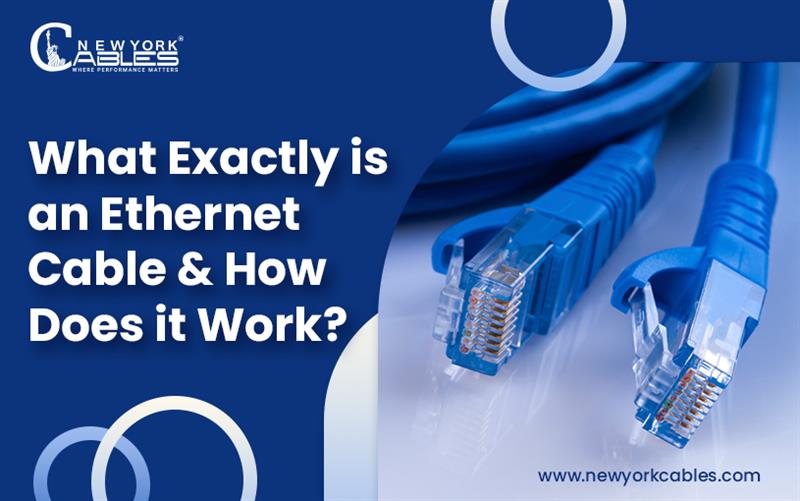
Ethernet cable is an important component of a wired network. It connects devices like computers, routers. It allows these devices to share data and access the internet. Ethernet cables are reliable and fast. They are commonly used in home networks, corporate offices and data centers.
When it comes to length, ethernet cables might have some limitations. However, with the introduction of new characteristics in the updated categories, these limitations have been minimized.
How Does an Ethernet Cable Look?
Ethernet cables might look like telephone cables but they are thicker and sturdier. They transfer high data loads at a greater speed. The Ethernet cable contains eight wires. These eight wires are grouped into four pairs and are twisted together. Due to this reason it is also called twisted pair cable. A tighter twist reduces electromagnetic interference generated from nearby or within resources.
Cables can be found in different colors. This helps with organization especially in larger setups. While color does not affect the performance, tighter twists and shielding does. Outer part of the ethernet cable is called a cable jacket. Two most widely used jackets are named as CMR Riser and CMP Riser. Cable jacket protects the internal components from getting damaged. Each cable jacket is used in a specific environment for safety, compliance with local codes, and physical durability.
Different Categories of Ethernet Cables
The most common categories of ethernet cables are Cat5e, Cat6, and Cat6a. Each category has its own specifications depending on speed, frequency, and performance standards.
Cat5e
Enhanced version of older Cat5 cable. It supports data transfer at a speed of 1 Gbps up to a distance of 50 meters and 100 Mbps over a distance of 100 meters. It has a bandwidth of 350 MHz with a diameter of 24 AWG. Cat5e is basically used in home and small office networks.
Cat6
It provides better performance than Cat5e due to its larger diameter of 23 AWG and tighter twists. It supports 10 Gbps speed up to 50 meters and 1 Gbps over a full distance of 100 meters due to its 550 MHz bandwidth. Commonly used in educational institutes, hospitals, and also in home networks for future readiness.
Cat6a
Augmented version of Cat6 cable, Cat6a transfers data at speed of 10 Gbps over a distance of 100 meters. It is mainly used in data centers and industries. It has 23 AWG thicker conductor and 750 MHz bandwidth.
Shielding and Construction Types
Ethernet cables can be shielded (STP) or unshielded (UTP) depending on environment and need. Shielded cables provide protection from EMI and external interferences.
Shielded Twisted Pair
Such Ethernet cable has an extra layer of protection around each twisted pair. This layer is made of aluminum foil or braided metal. STP cables are mainly used in data centers where interference is higher due to the presence of large machinery, electronic devices, and power cables. STP cables are more expensive and harder to install than UTP cables.
Unshielded twisted pair
These cables are best choice for places where interference is less.To make installation easier with less cost, a unique type of UTP cable is available named as F/UTP (Foiled/ Unshielded Twisted Pair). In this cable, the whole conductor is shielded by an aluminum foil, which can get rid of external interference and is cheaper than shielded cable.
The construction of a cable varies depending on the material used. There are two main types of cable when it comes to conductors named as (Bare Copper) and (Copper Clad Aluminum).
1) Bare Copper Ethernet Cables:
These cables use single copper wires for each conductor. They are better for long runs without getting overheated and provide great performance. They are commonly used for permanent installation in places where high performance is necessary.
2) Copper Clad Aluminum Ethernet Cables:
These cables use aluminum wires cladded by copper as a conductor. CCA cables are flexible and good for short runs. Cost of such cables is less compared to bare copper ethernet cables and are easier to install.
Ethernet vs. Wireless Technology
Wireless technology like Wifi and Bluetooth is now used in homes and offices. Modern laptops and mobiles do not have ethernet ports making them applicable only for wireless connection. Wireless networks offer convenience but they can suffer from network failures and intermittent connections due to distance, walls, and interference.
On the other hand, ethernet cables offer reliability, stability and speed. In places where performance is more important than convenience, ethernet cable is the best choice.
Final Thoughts
Ethernet cables play an important role in building a stable and fast network. From basic Cat5e cables to high-performance Cat6a Ethernet cables, there are many options to fit your needs.
At NewYork Cables, we have over a decade of experience in the cabling industry. We offer a wide range of Ethernet cables, including Cat5e, Cat6, Cat6a, and related accessories like RJ45 connectors. All our products are made with high-quality materials and tested for performance.
Frequently Asked Questions
What is the purpose of an Ethernet cable in a network?
An ethernet cable is a component of a wired network which transfers data at reliable speed from one device to another. It offers superior speed, stability, and reliability than wireless connection.
What is the difference between Cat5e, Cat6, and Cat6a Ethernet cables?
Cat5e supports speeds up to 1 Gbps and is suitable for home and small office networks. Cat6 has tighter twists and large diameter of 23 AWG, supporting 10 Gbps over short distances up to 50 meters. On top of them, Cat6a is the augmented version of Cat6. It supports 10 Gbps speeds over the full 100-meter distance. It is ideal for enterprise and data center applications.
Are shielded Ethernet cables better than unshielded ones?
Shielded Ethernet cables (STP or F/UTP) protect against electromagnetic interference (EMI), making them ideal for environments with heavy electronic equipment or machinery. On the other hand, Unshielded cables (UTP) cost less and are sufficient for home and small office networks with minimal EMI.
What’s the difference between bare copper and CCA Ethernet cables?
Bare copper cables use single copper wire as conductor. They offer superior conductivity and are rigid. These cables are suitable for permanent installation and long runs. CCA (Copper Clad Aluminum) cables are cost effective and ideal for short runs.
